
The World Brain Mapping Foundation: Mission, Money, and the Epstein Network
A Black Feather investigation into the World Brain Mapping Foundation (WBMF) and its parent organization the Society for Brain Mapping and Therapeutics (SBMT)

BLACK FEATHER STRATEGIC INTELLIGENCE NETWORK - Investigative Series: The Bio-Digital Empire
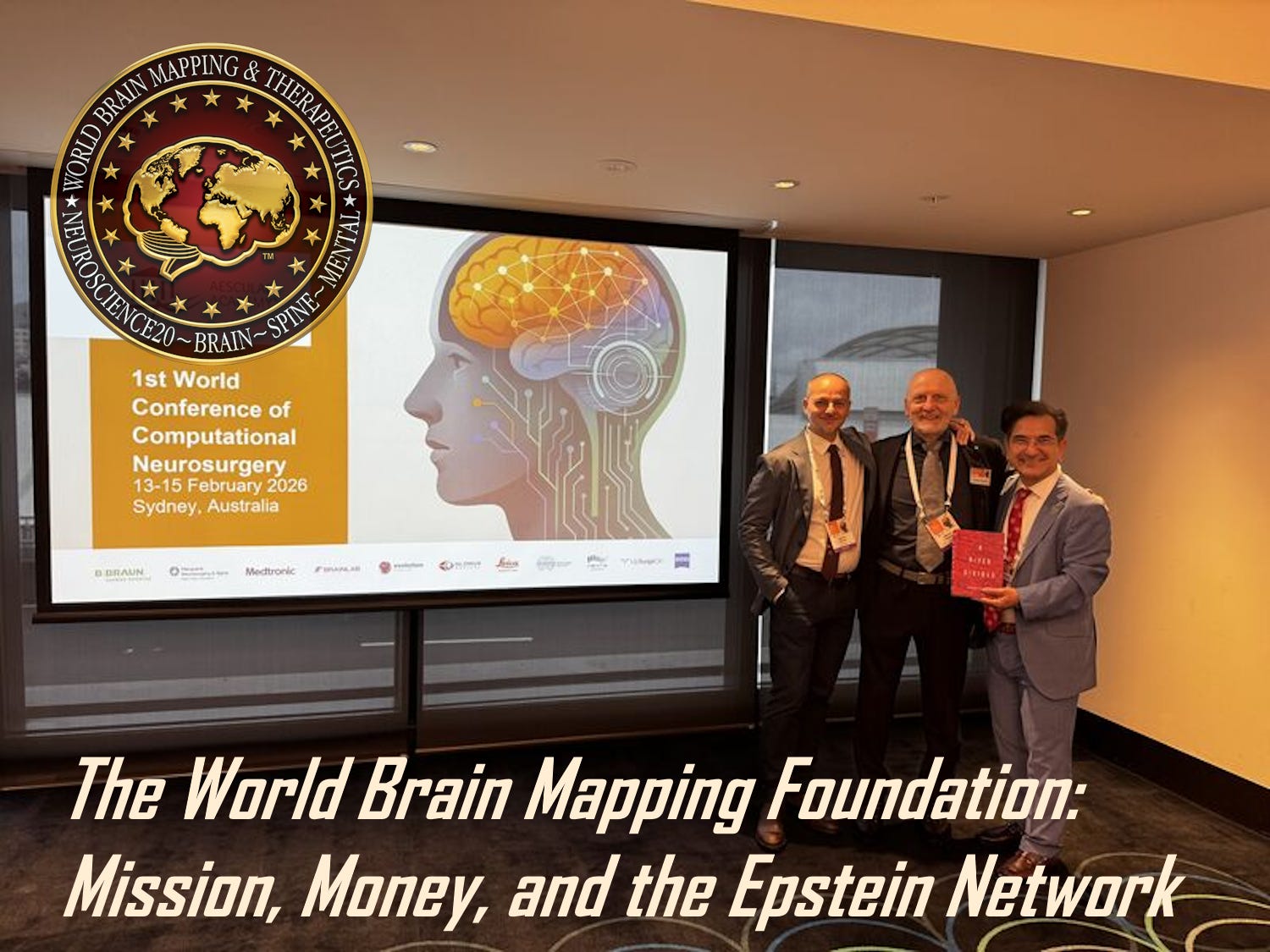
The World Brain Mapping Foundation: Mission, Money, and the Epstein Network
A Black Feather investigation into the World Brain Mapping Foundation (WBMF) and its parent organization the Society for Brain Mapping and Therapeutics (SBMT) — their stated mission, their institutional funding architecture, and the documented intersections between their leadership network and the financiers, scientists, and institutions of the Epstein neuro-philanthropy orbit.
Published: March 2026 — Sources: worldbrainmapping.org; brainmappingfoundation.org; Wikipedia; US DOJ Epstein Files (2026); Harvard University OGC Report (2020); MIT Goodwin Procter Fact-Finding Report (2020); Nature; Fast Company; USC Annenberg Media; AAAS Science; PMC/NCBI; LinkedIn; DARPA programme documentation
I — EXECUTIVE SUMMARY
The World Brain Mapping Foundation (WBMF) and its operational twin, the Society for Brain Mapping and Therapeutics (SBMT), constitute one of the most strategically positioned neurotechnology organisations in the United States. Founded in 2004 at the intersection of NASA, Caltech, and the USC Keck School of Medicine by neuroscientist Babak Kateb, SBMT has in twenty years grown from a fifteen-person think-tank into a self-described global consortium of over 100,000 neuroscientists, with a congressional lobbying arm, a humanitarian gala marketed as the “Oscars of neuroscience,” and formal affiliations with NIH, NASA, DARPA, and the Obama and Biden White Houses.
This investigation examines three questions. First: what does WBMF/SBMT actually do, who funds it, and what is its stated vision for the future of neurotechnology? Second: which individuals in its leadership and award networks appear in the independently documented orbit of Jeffrey Epstein’s neuro-science philanthropy? Third: what do those intersections, taken together and set against the broader DARPA-funded brain-computer interface landscape, tell us about the concentration of power and interests in the global brain-mapping enterprise?
II — INSTITUTIONAL PROFILE: WBMF / SBMT
A. Origins and Structure
The organisation was born from a 2003 meeting at NASA’s Jet Propulsion Laboratory, convened by Babak Kateb together with Wolfgang Fink and John George of JPL, drawing fifteen scientists from NASA, Caltech, and USC. This founding triangle — space agency, elite engineering institute, medical school — established the institutional DNA that defines SBMT to this day: a conviction that the most important advances in brain science will come not from neuroscience alone but from the aggressive transfer of technology developed for defence and space applications into clinical medicine.
In 2004, Kateb, Farzad Massoudi, and Warren Grundfest incorporated the organisation as a 501(c)(6) non-profit. The initial name, the International Brain Mapping and Intra-operative Surgical Planning Society (IBMISPS), was changed by member vote in 2011 to the Society for Brain Mapping and Therapeutics. The World Brain Mapping Foundation was established as the charitable arm, incorporated as a separate 501(c)(3) entity, providing a donation-eligible vehicle alongside the member organisation.
Headquarters are located at 2080 Century Park East, Suite 500, Los Angeles, CA 90067 — a prestigious Century City address that signals institutional ambition. The organisation claims a membership of over 100,000 neuroscientists globally and near 3,000 industry contacts.
B. Stated Mission and Vision
SBMT’s official mission is the promotion of rapid, safe, and cost-effective translation of emerging technologies into diagnostic and therapeutic neuromedicine. Its formal research areas include brain tumours, stroke, epilepsy, Alzheimer’s disease, Parkinson’s disease, traumatic brain and spinal cord injuries, autism, PTSD, and related psychiatric conditions.
The WBMF’s stated mission extends this with an explicit military and humanitarian dimension: the organisation was established, in its own words, to “translate state-of-the-art technologies from Space and defense industries into neuroscience to bring the most advanced medicine to wounded warriors, veterans and civilians.” => This framing — defence-to-clinic technology transfer, with veterans as the primary beneficiary population — is not incidental. It is structural.
“We are investing for a world where veterans, civilians, and even those in war-torn regions have access to the most advanced brain, spine, and mental health treatments. WBMF is making that vision a reality.”
— WBMF official mission statement, worldbrainmapping.org
What the mission statement does not say, but what the research areas and institutional partnerships make clear, is that WBMF/SBMT sits at the precise intersection of three domains that, taken together, constitute the frontier of what critics call the bio-digital empire: nanotechnology applied to the central nervous system, brain-computer interfaces enabling bidirectional neural communication, and state-of-the-art imaging capable of mapping neural activity at increasingly granular resolution. Each of these domains has dual use potential that the organisation’s literature does not address.
C. Funding Architecture
SBMT’s funding sources, as stated on its website and in published materials, include US Government agencies (NIH, NASA, DARPA, and the Department of Defense Veterans Affairs network), EU and Asian government agencies, foundations, and multinational corporations. The annual World Congress brings pharmaceutical companies, medical device manufacturers, and technology investors together with researchers and policymakers.
Specific named institutional partners identified from the organisation’s own materials and from published accounts include NASA/JPL, Caltech, USC Keck School of Medicine, Cedars-Sinai Medical Center, City of Hope Comprehensive Cancer Center, the Australian Government and Australian Biotech consortium, the Canadian Government and scientific community, and more than 200 universities and research institutions across multiple continents.
FUNDING ARCHITECTURE NOTE
SBMT is a 501(c)(6) — a non-profit trade association, not a charity. Its financial disclosures are therefore governed by different rules than those of a 501(c)(3). WBMF, the charitable arm, is the 501(c)(3). The separation of these two entities means that trade association funding flows (membership dues, corporate sponsors) are not subject to the same public disclosure requirements as charitable donations. This is a standard legal structure but it limits the ability of external observers to trace the full funding picture without IRS Form 990 access.
D. Leadership Structure
The organisation is controlled by a concentrated leadership with Babak Kateb at the centre of every entity in the network. His titles as of 2026 are: Founding Chairman of the Board and CEO of SBMT; President and Scientific Director of WBMF; Director of the National Center for Nano-BioElectronics (NCNBE); Director of the Brain Technology and Innovation Park (BTIP); Co-Founder of Aramis Therapeutics; Board of Advisors of Beomni; Chairman of the Science Advisory Board of Infinity Arc; and Editor of the textbooks Nanoneuroscience and Nanoneurosurgery and Neurophotonics and Brain Mapping. No individual in the organisation has a comparable breadth of institutional control.
The Board of Directors is listed as 61 members across six pages of the organisation’s website. Key board members identified from public records include Andre Machado (Chairman of the Neurosurgical Institute, Cleveland Clinic Foundation); Dawn S. Eliashiv (Professor of Neurology, Co-Director, UCLA Seizure Disorders Center); Jennifer Fogarty (Chief Scientific Officer, Translational Research Institute for Space Health, Baylor College of Medicine); Julie Pilitsis (Dean, Charles E. Schmidt College of Medicine, Florida Atlantic University); Theodore W. Berger (Professor of Biomedical Engineering, David Packard Chair, Director Center for Neural Engineering, USC Viterbi); and Navid Sadoughi (Neurosurgery and Spinal Pain Management). The 2025–2026 elected president is Namath Hussain.
Historical award recipients at the Gathering for Cure Gala — WBMF’s flagship public-facing event — include Stephen Hawking (2015 Beacon of Courage), Harrison Ford (2021), Goldie Hawn (2023), Congresswoman Gabby Giffords (two-time recipient), Anthony Fauci (Humanitarian 2021), Sanjay Gupta (Humanitarian 2021), Gary Michelson and Alya Michelson (Humanitarian 2024), and Deepak Chopra (special guest 2023).
III — THE EPSTEIN NEUROSCIENCE NETWORK: A DOCUMENTED PROFILE
A. Epstein’s Investment Strategy in Brain Science
Jeffrey Epstein’s interest in neuroscience was not incidental. It was systematic, deliberate, and strategically concentrated at the highest levels of the field. According to the DOJ files released in 2026 and the Harvard and MIT institutional review reports of 2020, Epstein cultivated relationships with neuroscientists, cognitive scientists, and consciousness researchers across multiple elite institutions, using the promise of unrestricted private funding to bypass the bureaucratic constraints of federal grant mechanisms.
In 2003, Epstein donated $6.5 million to establish Harvard’s Program for Evolutionary Dynamics (PED) under mathematician Martin Nowak — a total that grew to $9.1 million in Harvard gifts between 1998 and 2008. He became a board member of Harvard’s Mind, Brain and Behavior Committee. He made Psychologist Steven Kosslyn’s department a base for his visiting researcher status. He funded NeuroTV, an academic video network focused on neuroscience interviews. He supported Ed Boyden— co-inventor of optogenetics (light-based neural control) — via MIT’s Media Lab. He funded MIT mechanical engineer Seth Lloyd’s quantum computing research. He financed Joscha Bach’s artificial consciousness research. He hosted gatherings on “the nature of consciousness” at his residences, attended by neuroscientists and philosophers. He corresponded with Antonio Damasio, Director of USC’s Brain and Creativity Institute.
“Epstein was a latter-day eugenicist whose interests were tied to a delusional notion of seeding the human race with his own DNA — and he aimed his money exactly at research on the genetic basis of human behaviour.”
— Naomi Oreskes, Scientific American
The pattern is not random. Epstein’s brain science investments clustered around five themes:
consciousness and its manipulation; evolutionary dynamics and human behaviour; brain-computer interfaces and optogenetics; artificial intelligence and machine consciousness; and the physical extension of life (cryonics, transhumanism). These are not the areas where most brain disease funding goes. They are areas at the intersection of cognitive control, behaviour prediction, and human enhancement — precisely the domains that also drive DARPA’s neural interface programmes.
B. Key Epstein Network Figures in Neuroscience
The following individuals appear in the DOJ Epstein files or in the institutional review reports of Harvard and MIT as having documented relationships with Epstein’s neuro-science philanthropy. This is not a comprehensive list. It reflects the individuals whose institutional affiliations and WBMF/SBMT connections have been verified against primary sources available to this investigation.
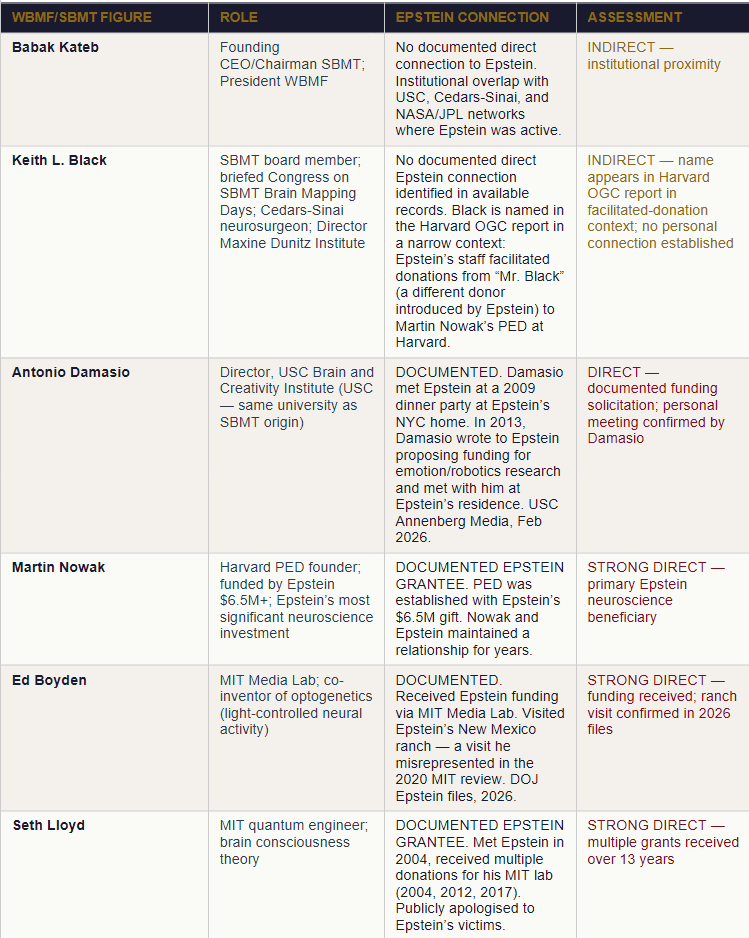
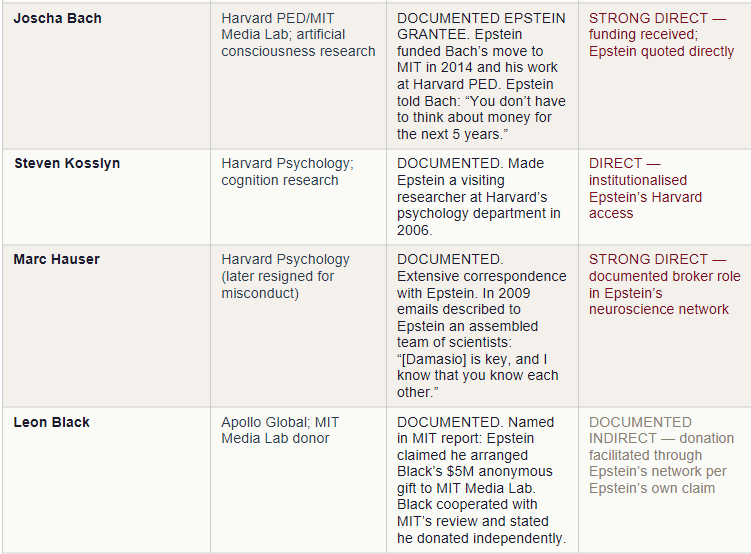
Table sources: US DOJ Epstein Files (2026); Harvard University OGC Report (2020); MIT Goodwin Procter Fact-Finding Report (2020); USC Annenberg Media (Feb 2026); Nature (Feb 2026); Fast Company (Feb 2026); AAAS Science; fancycomma.com (Mar 2026). Assessment ratings reflect only documented connections in available public sources; they are not characterisations of legal culpability.
IV — INTERSECTION ANALYSIS: WBMF/SBMT AND THE EPSTEIN ORBIT
A. The USC Node
The most structurally significant intersection in this investigation is the University of Southern California. SBMT was founded at USC’s Keck School of Medicine. SBMT’s current CEO Babak Kateb conducted his research fellowship there. Theodore W. Berger, a key SBMT board member, directs USC’s Viterbi School Center for Neural Engineering — one of the most advanced neural prosthetics and brain-computer interface research centres in the world. And Antonio Damasio, Director of USC’s Brain and Creativity Institute, has documented contact with Jeffrey Epstein that included a funding solicitation meeting at Epstein’s home.
Damasio is not a member of SBMT’s board. But the institutional proximity is exact: the scientist who most directly sought Epstein’s funding for neuroscience research is housed in the same university from which SBMT was launched and to which its leadership structure remains institutionally anchored. The USC Brain and Creativity Institute and SBMT’s National Center for Nano-BioElectronics operate within the same university’s ecosystem.
B. The Harvard/MIT Node
The Harvard Program for Evolutionary Dynamics, built with Epstein’s $6.5 million founding gift, was specifically focused on the mathematics of evolution as applied to disease, consciousness, and human behaviour. Martin Nowak, its director, was Epstein’s primary beneficiary in neuroscience. The MIT Media Lab received $850,000 from Epstein across fifteen years, funding work in brain-computer interfaces (Ed Boyden’s optogenetics) and artificial consciousness (Joscha Bach).
SBMT’s formal connections to Harvard and MIT are those of any major neuroscience organisation: shared membership, joint publications, conference presentations. No SBMT leadership figure has been documented in direct personal contact with Epstein from available sources. But the network of scientists who passed through SBMT’s annual congresses and who also appear in the Epstein files is not small — it reflects the structural reality that Epstein targeted precisely the most visible figures in the field, and SBMT cultivates precisely those figures as members, speakers, and award recipients.
C. The Defence-Neuroscience Corridor
A third intersection that deserves particular analytical attention is the shared defence-technology corridor that runs through both WBMF’s institutional mission and Epstein’s documented funding interests. WBMF explicitly states that its core purpose is to “translate state-of-the-art technologies from Space and defense industries into neuroscience.” DARPA is named among SBMT’s government funders. The organisation’s National Center for Nano-BioElectronics is focused on precisely the nano-scale neural interface technology that DARPA’s N3 (Next-Generation Nonsurgical Neurotechnology) and NESD (Neural Engineering System Design) programmes are simultaneously developing for national security applications.
Epstein’s interest in this corridor was documented: he funded optogenetics research (neural control via light), artificial consciousness research, and brain-computer interface work. He met with neuroscientists to discuss consciousness manipulation. He reportedly expressed interest in transhumanist technologies including cryonics and neural upload. The overlap between what Epstein was trying to fund and what WBMF’s stated mission advances is not coincidental — it reflects the convergence of elite neuroscience, defence technology, and private capital around the same set of questions about the human brain.
ANALYTICAL DISTINCTION
This section identifies structural and personnel-level intersections between WBMF/SBMT’s network and Epstein’s documented neuroscience orbit. It does not claim that WBMF or SBMT as organisations had any knowledge of, involvement in, or benefit from Epstein’s criminal activities. The intersections identified are at the level of individual scientists operating simultaneously in both networks — a pattern that characterises much of elite American neuroscience given Epstein’s systematic cultivation of the field’s most prominent figures.
V — THE BROADER PICTURE: BRAIN MAPPING AS POWER INFRASTRUCTURE
A. What Brain Mapping Enables
The term “brain mapping” sounds clinical. Its implications are not. The technologies that WBMF/SBMT promotes — high-resolution imaging of neural activity, nanotechnology-enabled brain interfaces, optogenetics, brain-computer interfaces, neural prosthetics, directed transcranial stimulation — collectively constitute an emerging infrastructure for the reading, recording, and in some cases influencing of human brain states.
DARPA’s own programme descriptions are unambiguous:
N3 aims at bidirectional neural interfaces for national security use; SUBNETS (Systems-Based Neurotechnology for Emerging Therapies) aims at monitoring and stimulating neural circuits; RAM (Restoring Active Memory) aims at neural modulation for memory restoration and, by implication, alteration.
WBMF’s stated population of primary beneficiaries — wounded warriors and veterans — is clinically legitimate and has real therapeutic value. It is also, in the context of this investigation’s broader series, worth noting that the same technology capable of restoring a veteran’s cognitive function after traumatic brain injury is capable, at the research frontier, of being directed toward other uses. The organisation’s own literature acknowledges the dual-use problem only in its positive framing: space and defence technology transferred into medicine. It does not address the reverse direction.
B. The Concentration Problem
What emerges from this investigation is a picture of extraordinary institutional concentration. A single founder, Babak Kateb, controls simultaneously the leading non-profit neuroscience society, its charitable foundation, its nano-bioelectronics research centre, its technology innovation park, a therapeutics company, an advisory board position at a robotics company, and two textbooks. This organisation has shaped Obama’s BRAIN Initiative, Biden’s Cancer Moonshot, and multiple G20 brain initiative frameworks. Its annual congress brings together the scientists, policymakers, and industry investors who collectively determine the direction of global neuroscience.
This concentration is not evidence of wrongdoing. It is, however, a structural fact that demands transparency. When a single non-profit organisation can simultaneously conduct research, advocate for legislation, fund innovation parks, award the most visible prizes in the field, and cultivate relationships with the defence establishment and private capital — the question of whose interests that organisation serves, and with what accountability, is not paranoid. It is the standard question of institutional power analysis.
C. Epstein as a Mirror
Jeffrey Epstein’s documented investment in neuroscience — his cultivation of the most prominent researchers in consciousness, brain-computer interfaces, and human behaviour — did not create the field’s power structures. He exploited and reflected them. He found scientists frustrated by federal grant bureaucracy and offered unrestricted money. He found institutions hungry for prestigious donors and offered his name. He found researchers working at the frontier of what can be done to the human brain and embedded himself in their social world.
The question raised by the intersection between the Epstein network and the WBMF/SBMT network is therefore not whether WBMF/SBMT is corrupt. The available evidence does not support that conclusion. The question is: what does Epstein’s ability to penetrate the most prestigious levels of this field so easily, and for so long, tell us about the absence of accountability structures in the governance of neuroscience research? And what does the concentration of control over that field’s direction, standards, and public presentation in a small number of interlocking organisations and individuals mean for the rest of us?
“The revelations underscore the allure of private money in research — Epstein offered a shortcut to funding, without the scrutiny and red tape that come with federal grants. It blinded people.”
— Leslie Lenkowsky, Indiana University, on the Epstein-academia relationship
V — THE BROADER PICTURE: BRAIN MAPPING AS POWER INFRASTRUCTURE
A. What This Investigation Establishes
WBMF/SBMT is the most strategically positioned neuroscience organisation in the United States, with formal ties to NASA, NIH, DARPA, two White House initiatives, and over 200 universities globally.
Its stated mission — defence-to-clinic technology transfer for brain, spine, and mental health — places it at the precise institutional intersection of the technologies most relevant to directed energy research, neural interface development, and the emerging bio-digital surveillance infrastructure.
Multiple scientists documented in the Epstein files have institutional affiliations with the same universities — USC, MIT, Harvard — from which WBMF/SBMT draws its leadership, members, and award recipients. At least one (Antonio Damasio, USC) has documented personal contact with Epstein that included a funding solicitation.
Epstein’s neuroscience investment strategy and WBMF/SBMT’s institutional mission overlap substantially in their focus on consciousness research, brain-computer interfaces, optogenetics, nanotechnology, and the defence-neuroscience corridor.
No direct organisational connection between WBMF/SBMT and Jeffrey Epstein has been established from available sources. The intersections identified are at the level of individual personnel operating simultaneously in both networks.
B. Lines Requiring Further Investigation
Full IRS Form 990 analysis for both SBMT (501c6) and WBMF (501c3) to establish the complete funding picture, including corporate sponsors, government grants, and major donors across the period 2004–2026.
Systematic cross-reference of the full 61-person SBMT Board of Directors against the DOJ Epstein files to identify any direct connections not visible in the sources available to this investigation.
Investigation of the Brain Technology and Innovation Park (BTIP) — its investors, tenants, government grants, and any defence or intelligence community relationships.
The National Center for Nano-BioElectronics (NCNBE): its specific research programmes, funding sources, and relationship to DARPA’s N3 and NESD programmes.
Full mapping of all WBMF Gathering for Cure Gala honorees against the Epstein files across all years from 2004 to 2026.
SOURCING NOTE: All factual claims in this article are sourced to primary or secondary sources cited inline. Epstein network connections are drawn exclusively from documents released by the US Department of Justice, institutional review reports commissioned by Harvard University and MIT, and journalism from Nature, Fast Company, USC Annenberg Media, and AAAS Science. WBMF/SBMT institutional information is drawn exclusively from the organisation’s own website (worldbrainmapping.org and brainmappingfoundation.org), LinkedIn, and Wikipedia. No claim in this article attributes criminal conduct to any individual named. Intersections identified are factual network connections, not accusations.
APPENDIX: Commercial Partners, Obama’s BRAIN Initiative, International Military Connections, Form 990 Financial Analysis, BTIP and NCNBE Structures
This appendix extends the findings of the primary article. It is designed to be inserted as a concluding section. All data is sourced from primary documents: ProPublica Nonprofit Explorer (IRS Form 990 data), the Obama White House BRAIN Initiative archive, SBMT’s own website and press releases, California Business Journal, and Wikipedia.
APPENDIX I — FORM 990 FINANCIAL ANALYSIS: WHAT THE IRS FILINGS REVEAL
A. Scope and Methodology
The financial data presented here derives from IRS Form 990 and 990-EZ filings for EIN 20-2865488, the 501(c)(3) entity known as the International Brain Mapping and Intraoperative Surgical Planning Foundation (IBMISPF), operating as the Brain Mapping Foundation (BMF) and World Brain Mapping Foundation (WBMF). Data was retrieved via ProPublica’s Nonprofit Explorer, which aggregates IRS digitised filings from 2011 to 2024. Filings cover fiscal years ending December of each year.
A critical structural note: the SBMT trade association itself operates under EIN 20-2793206 as a 501(c)(6) — a separate legal entity. The 501(c)(6) is not required to publicly disclose donor names and faces different disclosure rules than the 501(c)(3). The financial data below covers only the charitable arm. The SBMT’s full commercial revenue — conference registrations, sponsorships, membership dues — is not captured here. This is an important limitation; the 501(c)(3) arm is significantly smaller than the overall enterprise.
B. Revenue Trend: 2011–2024
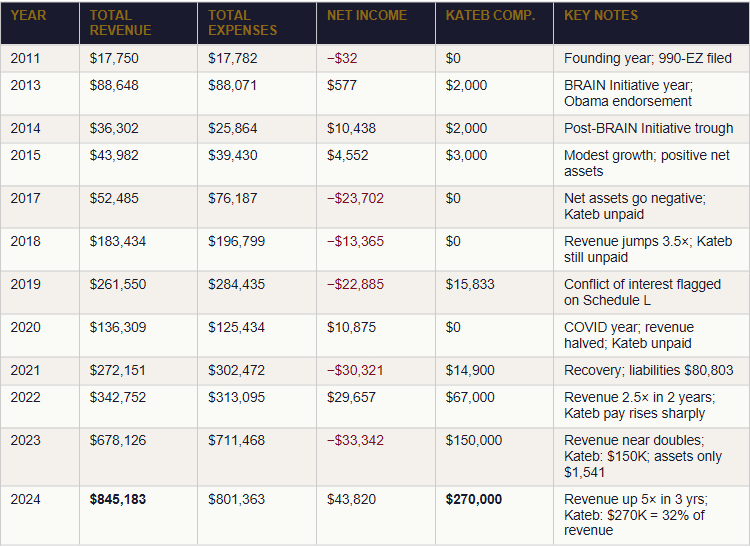
Source: ProPublica Nonprofit Explorer, IRS Form 990 filings, EIN 20-2865488 (IBMISPF / Brain Mapping Foundation / WBMF). All years are fiscal years ending December 31. Note: the 2016 filing does not appear in available ProPublica data.
C. Key Financial Findings
The data reveals several patterns that warrant analytical attention.
I. Explosive revenue growth 2021–2024
The foundation’s revenue grew from $272,151 in 2021 to $845,183 in 2024 — a 210% increase in three years. All of this revenue is classified as “contributions” with zero program service revenue, zero investment income, and zero earned income. This means the organisation’s rapid growth is entirely dependent on donations from undisclosed sources. The Schedule B (list of major contributors) is filed with the IRS but withheld from public disclosure as permitted under 501(c)(3) rules for non-private foundations. Identifying who is driving this growth is therefore not possible from publicly available data alone.
II. Babak Kateb compensation trajectory
Kateb’s documented compensation from the 501(c)(3) arm alone rose from $0 in multiple years to $270,000 in 2024 — representing 32% of the foundation’s total revenue that year. This is a high compensation-to-revenue ratio for a small nonprofit. By contrast, from 2017 to 2020, Kateb drew no salary at all from this entity, which raises questions about how he was otherwise compensated during those years, particularly given his multiple simultaneous roles at commercial entities (Smart Microscopy Inc, Aramis Therapeutics, AiM Medical Robotics advisory board, Infinity Arc science advisory board). No compensation from SBMT’s 501(c)(6) is visible in this data.
III. Structurally negative net assets
The foundation has operated with negative net assets (liabilities exceeding assets) almost continuously since 2017. In 2024, total assets were $15,176 against liabilities of $53,711. In 2023, total assets were only $1,541 against liabilities of $83,896. This means the organisation is technically insolvent on its balance sheet while simultaneously growing rapidly in revenue and executive compensation. The explanation is likely that the organisation operates on a cash-flow basis — contributions come in and are spent in the same period — but the pattern deserves scrutiny from any prospective major donor.
Iv. Conflict of interest transaction flagged (2019)
The 2019 Form 990 includes Schedule L, which is filed when an organisation reports a transaction with an interested person — i.e., a related-party transaction. The details of this transaction are contained in the Schedule L attachment to the 2019 filing. The publicly available ProPublica summary notes “Reported conflict of interest transactions” without further detail. Obtaining the full Schedule L from the 2019 filing would identify the nature and counterparties of the transaction.
FORM 990 INVESTIGATION RECOMMENDATION
A complete investigation of SBMT/WBMF’s finances requires:
obtaining the 501(c)(6) SBMT entity’s Form 990 or 990-EZ filings under EIN 20-2793206, which would capture conference revenue, membership dues, and corporate sponsorship income;
requesting the Schedule B (major donors) from the 501(c) filings under the Privacy Act or via a journalism-specific request to the IRS;
reviewing the full Schedule L from 2019 to identify the conflict of interest transaction; and
examining all Schedule O (supplemental information) attachments, which contain narrative descriptions of activities and related-party relationships.
These documents are obtainable by IRS Form 4506-A request or through direct FOI request to the IRS Exempt Organisations division.
APPENDIX II — PRESIDENT OBAMA AND THE BRAIN INITIATIVE: SBMT’S ROLE
A. The BRAIN Initiative: What It Was
On April 2, 2013, President Barack Obama announced the Brain Research through Advancing Innovative Neurotechnologies (BRAIN) Initiative at a White House event attended by approximately 200 scientists. The announcement proposed initial FY2014 expenditures of $110 million: $50 million from DARPA, $40 million from NIH, and $20 million from NSF. Obama directed DARPA, IARPA, FDA, and NSF to participate alongside major private foundations.
“There is this enormous mystery waiting to be unlocked, and the BRAIN Initiative will change that by giving scientists the tools they need to get a dynamic picture of the brain in action and better understand how we think and how we learn and how we remember.”
— President Barack Obama, April 2, 2013
By FY2016, the US Government investment had grown to an estimated $230 million annually (NIH: $135M, DARPA: $95M, NSF, FDA), supplemented by over $240 million in private commitments from the Allen Institute for Brain Science, Howard Hughes Medical Institute, Kavli Foundation, and the Salk Institute. Major corporations including GE, GlaxoSmithKline, and Inscopix committed a further $30 million+ in R&D investments. The total BRAIN Initiative investment over its lifespan exceeded $3 billion.
DARPA’s $95 million annual investment in FY2016 was focused on programmes that are directly relevant to the research agenda SBMT promotes: the Restoring Active Memory (RAM) programme conducting human clinical trials on memory encoding; the Systems-Based Neurotechnology for Emerging Therapies (SUBNETS) programme for neural circuit monitoring and stimulation; the Neuro-Function, Activity, Structure, and Technology (Neuro-FAST) programme testing optical and photonic neural sensing. Each of these corresponds to research domains explicitly covered in SBMT’s annual congress programme.
B. SBMT’s Claimed Role
SBMT claims publicly and in multiple press releases to have “played a significant role in the formulation, planning and execution of Obama’s BRAIN Initiative.” This claim is also reflected in Wikipedia’s SBMT entry and in the Brain Mapping Foundation Wikipedia entry. The organisation’s own press releases confirm it endorsed Obama for its “Pioneer in Healthcare Policy Award” specifically for his support of human brain mapping research.
Babak Kateb’s profile page on the SBMT website displays a prominently referenced letter from Barack Obama. The AiM Medical Robotics press release appointing Kateb to its medical advisory board (July 2021) states explicitly: “Dr. Kateb played a significant role in the formulation of President Obama’s BRAIN initiative, and he works with governments around the world to support research of the brain.”
SBMT’s specific contribution to the BRAIN Initiative is documented in its own materials as follows: the G20+ World Brain Mapping and Therapeutic Initiative — renamed Neuroscience20 — was “pioneered” by SBMT in 2013 simultaneously with the BRAIN Initiative announcement. SBMT also hosted ten congressional briefings over the decade prior to 2024 through its Brain Mapping Day programme at the US Congress. The Nanoneuroscience and Nanoneurosurgery textbook (Springer, 2024) contains a chapter explicitly titled “Nanoneuroscience and Nanoneurosurgery: A Key Component of Presidential Brain Mapping and Cancer Moonshot, Neurotechnology and Brain Mapping Day Policy Initiatives.”
C. Analytical Assessment of the SBMT-BRAIN Initiative Relationship
The available evidence supports the conclusion that SBMT functioned as an advocacy and convening organisation that contributed to the political climate that made the BRAIN Initiative possible, rather than as a principal scientific actor in the initiative’s design. The NIH’s formal advisory working group for the BRAIN Initiative was led by Cornelia Bargmann (Rockefeller University) and William Newsome (Stanford), with ex officio participation from DARPA and NSF. SBMT is not listed among the principal bodies designing the initiative.
However, SBMT’s role as a congressional lobbying force — ten briefings over ten years, annual Brain Mapping Days at both the US Congress and multiple national parliaments globally — is documented and real.
The organisation’s claim to have “influenced” the BRAIN Initiative is more accurately characterised as:
SBMT was among the advocacy organisations that created and maintained the political receptivity that allowed the initiative to launch, and that framing of brain research as a national priority requiring government investment was one SBMT had been advancing since 2004.
ANALYTICAL NOTE
The SBMT-BRAIN Initiative relationship illustrates a structural dynamic in elite science policy: private organisations with government and defence connections shape the political environment in which public funding decisions are made, and then claim credit for those decisions. This is not necessarily inappropriate — it is how science advocacy works. But the circularity of the relationship (DARPA funds brain research; SBMT advocates for brain research with DARPA framing; DARPA increases funding; SBMT claims credit for the increase) deserves to be named explicitly when evaluating SBMT’s institutional influence.
APPENDIX III — COMMERCIAL PARTNERSHIPS: A DOCUMENTED INVENTORY
A. Government and National Laboratory Partners
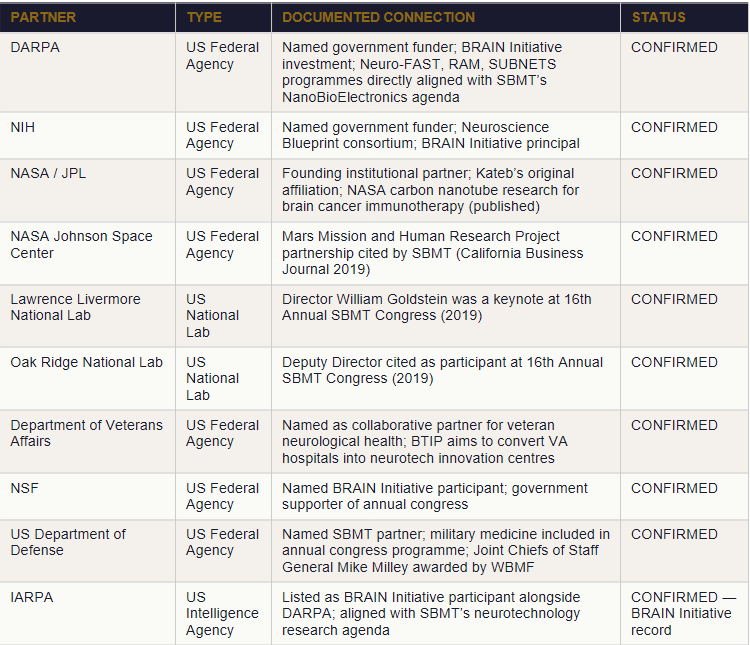
Note: ‘CONFIRMED’ indicates the connection appears in SBMT’s own published materials, Wikipedia, or independently published press releases. It does not indicate the nature or financial value of the relationship.
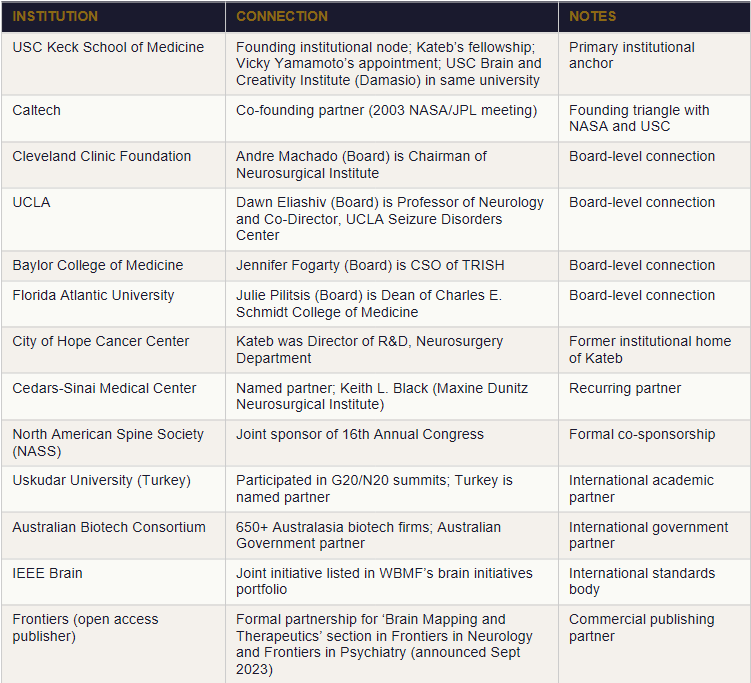
B. Academic and Medical Institutional Partners
C. Private Sector and Commercial Partners
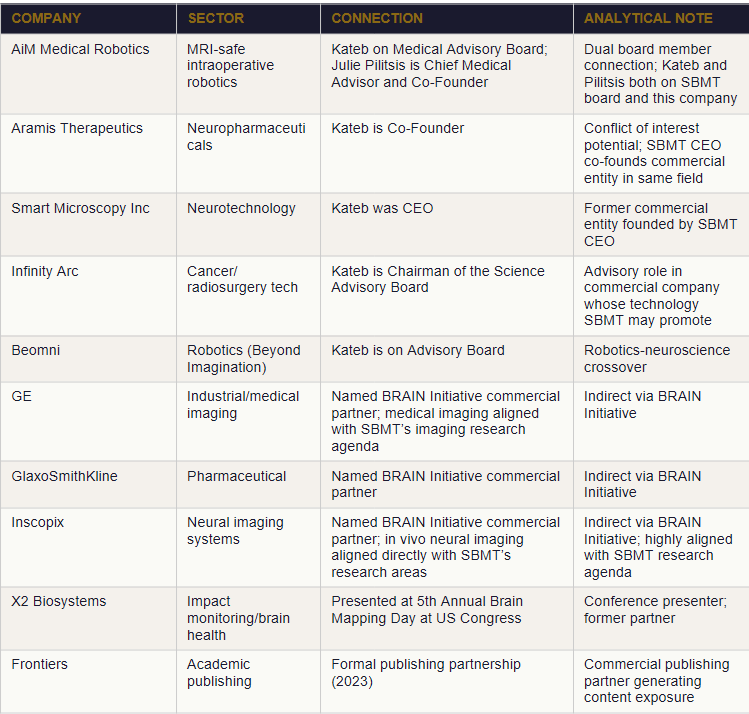
Note: Kateb’s simultaneous roles as CEO/Chairman of SBMT and as co-founder, CEO, or advisory board member of multiple commercial entities in the same neurotechnology space raises conflict of interest questions that the 2019 Schedule L — flagging a conflict of interest transaction — may address. This should be a priority document for any investigator reviewing SBMT governance.
APPENDIX IV — INTERNATIONAL CONNECTIONS: MILITARY, SCIENTIFIC, GOVERNMENTAL
A. The Neuroscience20 (N20) Global Infrastructure
SBMT’s most significant international structure is the Neuroscience20 (N20) initiative, launched in 2013 as the G20+ World Brain Mapping and Therapeutic Initiative. The N20 model is explicit: hold a neuroscience summit in the host country of each G20 presidency, embedding brain technology advocacy directly into the global governance framework that coordinates the world’s largest economies.
N20 summits have been held, per SBMT’s own published materials and press releases, in the following countries in conjunction with their G20 host years: Australia, Turkey, China, Germany, Argentina, Japan, Saudi Arabia, Italy, Indonesia, and India. The most recent N20 summit was held in Rio de Janeiro, Brazil, on November 16–17, 2024. A summit in South Africa (Johannesburg, Radisson Blu) was also scheduled for 2025.
Each summit is described as “aiming to contribute to President Obama’s BRAIN initiative and President Biden’s Cancer Moonshot Initiative to expand action on the current and upcoming initiatives across the G20 nations.” This framing — linking every global summit to US presidential science policy — is analytically significant: it positions SBMT as the international transmission mechanism for American brain science policy priorities.
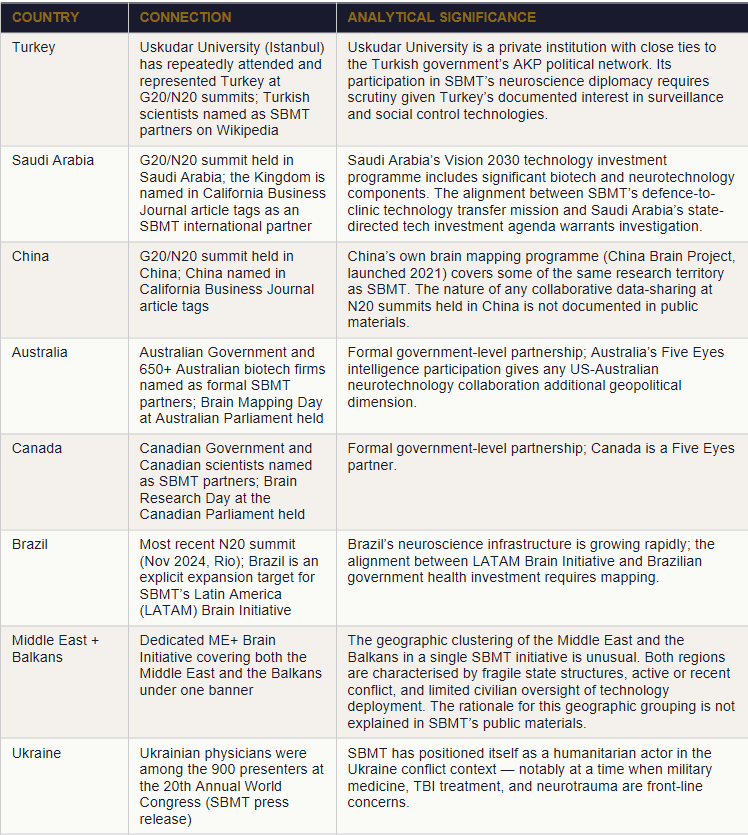
B. Country-Specific Connections of Investigative Significance
C. Military Dimension of International Connections
SBMT’s military engagement is not peripheral — it is structural. The organisation’s website lists “Military Medicine and Neurotrauma (TBI, micro-TBI)” as a named research subcommittee. US Army General James Murray and Assistant Secretary for Navy James Geurts were keynote speakers at the 16th Annual Congress (2019). Joint Chiefs of Staff Chairman General Mark Milley was the sole military figure awarded by WBMF for the COVID-19 response — a designation the organisation described as making SBMT and WBMF “the only nonprofit organisations” to honour the US military in this way.
The significance of the military relationship extends beyond ceremony. DARPA’s stated goals for its BRAIN Initiative investment include “novel, neurotechnology-based capabilities for military personnel” and improvements in “the way we diagnose and treat warfighters suffering from post-traumatic stress, brain injury, and memory loss.” DARPA’s RAM programme was conducting its “first human clinical trials to identify how memories are encoded in the brain during learning and skill acquisition, with the ultimate goal of accelerating warfighter recovery after traumatic brain injury.” These goals are, on their face, humane. They are also, as a body of research, the foundation for more sophisticated applications of neural intervention that SBMT’s own research programme — nanotechnology, brain-computer interfaces, optogenetics — advances simultaneously.
APPENDIX V — BTIP AND NCNBE: STRUCTURE, INTENT, AND OPEN QUESTIONS
A. The Brain Technology and Innovation Park (BTIP)
The Brain Technology and Innovation Park is described by SBMT as “the world’s first” biotech park specifically dedicated to brain and spine neurological disorder therapeutics. The concept was publicly announced circa 2018, when the California Business Journal reported on SBMT’s plans to create the park in Los Angeles. By 2024, it remained in a planning and advocacy phase, with SBMT reporting that a BTIP team including Deborah Zelinsky had met with President Biden’s domestic policy advisors at the White House.
The BTIP’s stated purpose is to bridge the “valley of death” — the funding gap between mature research and commercial product that prevents clinical translation. Its proposed model is a physical innovation park that would co-locate biotechnology companies, NASA and US National Labs, academic institutions, nonprofits, and “venture philanthropy organisations,” alongside “venture funds, hedge funds and angel investors” in an integrated research-to-market ecosystem.
BTIP STRUCTURAL OBSERVATION
The BTIP model explicitly combines: (1) public institutions (NASA, National Labs, VA hospitals); (2) academic research; (3) commercial venture capital and hedge fund investment; and (4) a nonprofit organisation (SBMT/WBMF) as the convening and governance entity. This is a public-private technology transfer model in which a privately controlled nonprofit functions as the gatekeeper between government-funded research and commercial investment. The identity of the “venture funds, hedge funds and angel investors” SBMT proposes to engage in this structure has not been publicly disclosed. BTIP has not yet been physically built as of March 2026.
B. The National Center for Nano-BioElectronics (NCNBE)
The NCNBE is SBMT/WBMF’s flagship research infrastructure initiative. Founded and directed by Babak Kateb, it is explicitly described as focused on integrating nanotechnology, devices, imaging, and cellular/stem cell therapy. WBMF’s own materials describe WBMF as funding the NCNBE directly: “We fund groundbreaking SBMT initiatives like the Brain Technology and Innovation Park and the Nanobioelectronics Center.”
The NCNBE’s research agenda maps onto DARPA’s N3 (Next-Generation Nonsurgical Neurotechnology) programme, which aims to develop wearable neural interfaces using “nanotransducers” to enable non-surgical bidirectional brain-computer communication. Kateb’s own published research pioneered the use of NASA carbon nanotubes to activate macrophages for brain cancer immunotherapy — a direct application of the nanotechnology-to-clinical-medicine pipeline the NCNBE is designed to accelerate.
The NCNBE is physically located within SBMT’s institutional infrastructure at USC and City of Hope. Its specific funding sources beyond WBMF’s charitable contributions, its government grants, and any defence or intelligence community contracts are not publicly documented in available materials. This is one of the highest-priority gaps in the investigative record.
NCNBE INVESTIGATION GAP
The National Center for Nano-BioElectronics is the SBMT/WBMF entity whose research is most directly relevant to the bio-digital surveillance and directed energy weapon technology documented elsewhere in this series. Its government grant history, any DOD or DARPA contracts, and any classified or dual-use research programme affiliations should be the subject of FOIA requests to NIH, DARPA, and the DOD. The NCNBE’s specific current research outputs, postdoctoral and faculty roster, and international collaborations are not visible in publicly available materials.
APPENDIX VI — SYNTHESIS: WHAT THE SUPPLEMENTARY INVESTIGATION ADDS
A. The Financial Picture
The Form 990 data reveals an organisation that is, by the standards of its public presentation, remarkably small. Annual revenue of $845,183 in 2024 — with negative net assets and essentially no working capital — would not normally support claims of influencing presidential science policy, running ten G20 summits across four continents, and operating a global network of 100,000 scientists. The most likely explanation is that the 501(c)(3) foundation is only one of multiple financial vehicles — the 501(c)(6) SBMT trade association being the larger entity — and that conference revenue, membership dues, and corporate sponsorships flowing through the SBMT side are not captured in this data. Obtaining the SBMT 501(c)(6) filings is therefore critical.
What is clear from the 990 data: the revenue trajectory is steep and recent (5x growth in three years), it is entirely donation-driven with no earned income, the CEO’s compensation now equals approximately a third of total annual revenue, there is a conflict of interest transaction in the 2019 record, and the organisation’s balance sheet is structurally negative. These features are consistent with an organisation that is scaling rapidly on the basis of a small number of significant donors whose identities are not publicly disclosed.
B. The Obama Connection
SBMT’s relationship to the BRAIN Initiative is real but should be characterised precisely: it was an advocacy and convening organisation, not a principal scientific actor. The initiative’s $3 billion+ investment went primarily to NIH-funded researchers, DARPA programme managers, and private foundations — not to SBMT directly. SBMT’s contribution was political: a decade of congressional briefings, annual Brain Mapping Days, and the international Neuroscience20 infrastructure that embedded brain technology advocacy into the G20 governance framework. This is influential work. It is not the same as designing the science.
The relationship also runs in a specific direction: SBMT’s work made brain neurotechnology more politically legible and more governmentally fundable. The organisations that benefited most financially from the BRAIN Initiative’s $3 billion+ — Allen Institute, Howard Hughes Medical Institute, Kavli Foundation, major pharmaceutical companies — are far larger and better-capitalised than SBMT. SBMT’s role was to create the political environment; others captured the financial upside.
C. The International Infrastructure as Strategic Asset
The Neuroscience20 global summit structure, with events in every major G20 host nation, constitutes a soft power infrastructure of significant strategic value. It places SBMT in direct contact with the neuroscience establishments of Turkey, Saudi Arabia, China, India, Brazil, and Indonesia — countries with very different relationships to civil liberties, surveillance, and the ethics of neural technology deployment. The nature of the relationships formed at these summits — what data is shared, what joint research is conducted, what bilateral agreements are formed — is not publicly documented. This gap is significant.
The Middle East and Balkans Brain Initiative — grouping these two geographically and politically distinct regions under a single SBMT banner — is the most analytically curious of SBMT’s international structures. Both regions contain populations that have been subject to state violence, social control, and in some cases documented use of directed energy or surveillance technologies. The rationale for this grouping, and the specific national partners engaged, requires investigation.
Sources: ProPublica Nonprofit Explorer — IRS Form 990 data, EIN 20-2865488 (2011–2024); Obama White House BRAIN Initiative Fact Sheet, April 2, 2013; Obama White House BRAIN Initiative FY2016 Fact Sheet; BRAIN 2025: A Scientific Vision (NIH); PMC/NCBI: ‘The NIH BRAIN Initiative’; AAAS Science: ‘What exactly is Obama’s $100 million BRAIN Initiative?’; Wikipedia: Society for Brain Mapping and Therapeutics; Wikipedia: Brain Mapping Foundation; worldbrainmapping.org (About, Initiatives, BTIP, NCNBE, WBMF pages); brainmappingfoundation.org (Initiatives page); California Business Journal (2019, 2024); PR Newswire: AiM Medical Robotics press release (July 2021); PR Newswire: BTIP announcement (March 2019); Frontiers/SBMT partnership announcement (September 2023); SBMT Press Releases archive; LinkedIn: Society for Brain Mapping and Therapeutics. All financial data from IRS filings as reported by ProPublica. Analytical assessments are those of Black Feather Strategic Intelligence.
You Can Download This Article As PDF Document Here
I’m nothing related to any of those foreign countries at all. I shouldn’t be treated like this : torturing and assaults and harassments. I’ve been targeted since 2001, autoimmune, pneumonia, and osteoporosis. -My doctor said people that have the same diseases actually died from their psychiatric meds. - Coma in 2003 and daily torturing. And used to have other small sickness too. I hope those abusers will be killed. I’ll definitely message those organizations and schools. I don’t think I can make it to 2030. Thank you for this information.